ASLTON, in Conjunction with NISLT, holds its Annual National Conference and Scientific Workshop
The Association of Science Laboratory Technologists of Nigeria (ASLTON), in conjunction with the Nigerian Institute of Science Laboratory Technology (NISLT), organized its 40th Annual National Conference and Scientific Workshop, tagged Rivers 2025.
The opening ceremony, held at the CBN Centre of Excellence, University of Port Harcourt, Rivers State, on Tuesday, 4th November 2025, with the theme “Efficient Policy Matrix: A Pathway to Sustainability and Productivity of the Science Laboratory Profession,” was attended by many dignitaries.
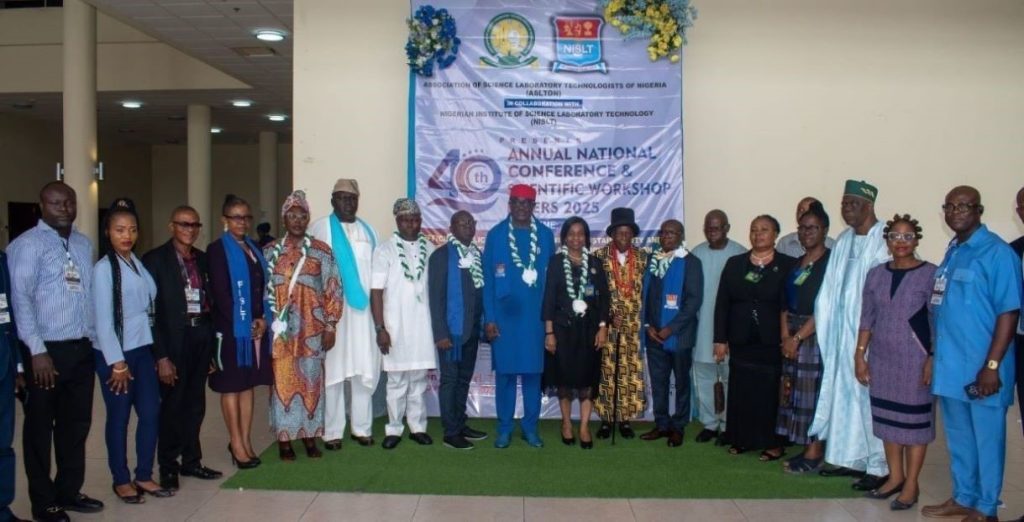
Members of the High Table at the Conference with University of Port Harcourt ASLTON Executives in a Group Photograph with the Acting DG, NISLT and the Pro-Chancellor, University of Port Harcourt (Middle)
Delivering her keynote remarks, the Permanent Secretary (PS), Federal Ministry of Innovation, Science and Technology (FMIST) Mrs. Esuabana Nko-Asanye who was represented by Mrs. Ronnel Gambo Dola said that science laboratories are the foundation of credible research, innovation, diagnostics, industrial development, public health systems and environmental monitoring, therefore an efficient national policy framework governing laboratory practice is critical to strengthening Nigeria’s competitiveness, innovation capabilities, and service delivery across all sectors.
The Permanent Secretary said Nigeria’s transition towards a knowledge-driven, innovation-based economy, depends on building strong, credible and sustainable scientific and laboratory systems, which aligned the theme for the conference with national and global frameworks including, National Science, Technology & Innovation Policy; National Development Plan (2021-2025); United Nations Sustainable Development Goals (SDGs); FMIST STI Roadmap (2017-2030); African Union STISA-2024 & Agenda 2063.
She informed participants at the conference that effective laboratory systems must ensure reliable research outcomes for public policy and national planning, stating that countries with strong laboratory governance frameworks achieve faster technological growth and improved socio-economic outcomes.
Talking about the current gaps and challenges of the laboratory ecosystem, she said, despite progress in national science and innovation reforms, continued experience has shown inadequate infrastructure with aged equipment and insufficient modern technology.
The PS said that the absence of prioritizing strategic policy to strengthen the laboratory profession and enhance national STI performance is a challenge to science and technology innovation, asserting that the successful implementation of strategic policies will result in technological development
She further insisted that a well-structured and efficient laboratory policy ecosystem is vital to Nigeria’s development aspirations to the extent that strengthening laboratory governance, infrastructure, human capital and innovation systems will position Nigeria as a regional leader in science, research, innovation and industrial development.
Also speaking at the occasion, the Pro-Chancellor and Chairman of the 17th Governing Council of the University of Port Harcourt, Senator Mao Ohuabunwa, said in his address that as a committed Fellow of NISLT, he has played a significant role in shaping the foundation of the Science Laboratory Technology (SLT) profession, especially his involvement in the ACT of Parliament in 2003 that establish the Nigerian Institute of Science Laboratory Technology.
Emphasizing the commitment of the University of Port Harcourt in advancing knowledge, driving innovation and serving as a bridge between academia and industry by hosting the conference and scientific workshop, the Pro-Chancellor said the chosen theme “Efficient Policy Matrix: A Pathway to Sustainability and Productivity of the Science Laboratory Technology profession” is both timely and important at a period when science and technology play a central role in development and global competitiveness.
Looking at four decades of sacrifice and contribution to national development by laboratory technologists and scientists, Senator Ohuabunwa said that what should shape the deliberations of participants at the conference and workshop should be the milestones already reached and the direction to be charted for the future. Having watched ASLTON and NISLT grow into formidable partners, setting high standards for ethics and practice, the distinguished Senator, stated that his dual roles have offered him the unique perspective to see the universities as cradles for research and scholarship, while professional bodies ensure that discoveries are translated into solutions for the society, as knowledge is no longer confined to books but applied meaningfully to solve problems.
Senator Mao Ohuabunwa, while maintaining that if Nigeria were to overcome challenges in the areas of environmental sustainability, healthcare, energy, and food production, the expertise of Science Laboratory Technologists is required for policymakers, researchers and industry leaders, stressing that the walls of the classroom, laboratory and factory must go down to allow collaboration where innovation flows freely across all sectors. He posited that the theme for the conference is very relevant because if taken seriously, it will create enabling environments where Science Laboratory Technology professionals can thrive in an equipped laboratory, where standards are enforced and innovation is encouraged. This will ensure that young graduates have opportunities to apply their skills, while also safeguarding the dignity of their profession, he quipped.
He said unequivocally that this 40th anniversary is not a mere commemoration of past achievements but a launching pad for the next phase of growth for the profession and therefore charged the technologists and scientists at the conference to allow their resolution and strategies provide blue print for the future of the SLT profession as they think boldly, responsibly and envision solutions that extend beyond today’s challenges and anticipate tomorrow’s needs.
Welcoming NISLT, ASLTON, participants and delegates to Rivers 2025, the Vice Chancellor of the University of Port Harcourt, Professor Owunari Abraham Georgewill who was well represented by the Deputy Vice Chancellor, Research and Development, Professor Angela Ine Frank-Briggs congratulated the organizers of the conference, affirming that 40 represents wisdom and balance, which bridge structure and growth as ASLTON and NISLT embodies stability rooted in experience and progress driven by insight, obviously indicating that today’s gathering represents the convergence of professional excellence, academic commitment and visionary leadership, all of which she said is indispensable to national growth.
Expressing his gratitude to the leadership of ASLTON and NISLT for their dedication that has inspired the University to support researchers, which has continually raise the bar for scientific education in Nigeria and their steadfast collaboration and continued contributions towards scientific excellence and professional advancement, Professor Owunari Abraham Georgewill said the University holds in high esteem the invaluable role that Science Laboratory Technology plays in national development, avowing that the laboratory is the heart of scientific inquiries, spaces where theory meets practice, where innovation is born and where future is tested and refined. She further stated that the synergy between the various universities across Nigeria and other professional bodies like NISLT and a professional association like ASLTON is both natural and necessary for the bond that exists between universities and key professional bodies to drive the advancement of science and technology in any country.
In his opening speech, the Acting Director General, Registrar and Chief Executive Officer, Nigerian Institute of Science Laboratory Technology (NISLT), Dr. Peter Adefisoye Oluwafisoye (FISLT), said the 40th edition of the annual national conference and scientific workshop marks a significant milestone, a testament to resilience, unity, and unwavering commitment to the advancement of Science Laboratory Technology in Nigeria, asking all Science Laboratory Technology (SLT) professionals to rededicate themselves to the ideals of the profession, discipline, innovation, integrity, and excellence as he prayed that the outcomes of the conference should strengthen the resolve of participants to uphold the standards of Science Laboratory Technology as an essential driver of Nigeria’s scientific and industrial advancement, insisting that new strategies must be put in place, aimed at improving efficiency, strengthening regulations, deepening professional development across all sectors, building bridges among members of staff and other stakeholders.
He said, in line with the Institute’s mandate, “To Advance Science Laboratory Technology Profession” Management has repositioned the Institute through education, professional practice and innovation nationwide, to enhance professionalism, accreditation of laboratory quality assurance, expansion of job opportunities, and promotion of policies that drive sustainability and productivity in the Science Laboratory profession.
Dr. Peter Adefisoye Oluwafisoye opined that the theme of this year’s conference could not be more apt. It underscores a key national and professional concern in the area of well-structured, evidence-based, and efficiently implemented policies to sustain the growth and productivity of Science Laboratory Technologists and Scientists in Nigeria, affirming that without coherent policy direction, efforts toward innovation, research, and manpower development risk becoming fragmented or unsustainable, which is why the opportunity to examine existing policies, identify gaps, and collectively design strategies that will promote a sustainable, productive, and globally competitive Science Laboratory Technology profession should not be jettisoned, noting that several policy documents have already been developed and forwarded to relevant government agencies for consideration and that the Nigerian Institute of Science Laboratory Technology would continue to play a pivotal role in formulating and enforcing policies that promote professionalism, competence, and ethical standards in laboratory practice across Nigeria.
He mentioned that 26 universities are currently running Science Laboratory Technology (SLT) degree programmes, 19 of which he said are officially recognized by the Institute, while 7 or more are yet to be formally captured. Several polytechnics are also running SLT at both National Diploma and Higher National Diploma levels.

Oath Taking by the New Fellows of the Institute at the Conference
The Acting Director General of NISLT stated that the profession continues to face challenges, including but not limited to inadequate laboratory infrastructure, limited research funding, limited integration into national policy frameworks, and uneven recognition within the science and innovation ecosystem.
He, however, said that the challenges also present opportunities to strengthen evidence-based policy formulation and implementation within the SLT sector, the Acting DG therefore advised that an efficient policy matrix must be in place to ensure that the Science Laboratory Technology profession not only survives but thrives in a rapidly evolving scientific and technological landscape as professionals are called to create and sustain an environment where every Science Laboratory Technology professional contributes meaningfully to national development through professional excellence, ethical conduct and innovative practice.
The President of the Association of Science Laboratory Technologists of Nigeria (ASLTON), Pastor Ayotunde Omorilewa, remarked that the SLT profession had come a long way and had weathered so many storms within the period of its existence and still has very many challenges ahead to overcome in the future. He stated that the profession may not have been where it ought to be, however, the profession is on the right path and at this stage, victory and proper recognition for the SLT profession is certain, emphasizing that the time is ripe for the SLT professionals to begin to reap the dividends of all their past efforts and sowing.
It became pertinent for the ASLTON national president to state that in the last two years of this conference, ASLTON had gained leverage from all angles, and it was high time they capitalized on those gained leverages and began to invent and innovate technology. For instance, he said, over sixty papers were presented at the conference held two years ago and last year, they had over one hundred papers presented. Already, he stated that he is aware that there are over one hundred papers in line for presentations at this conference. The national president of ASLTON informed the participants at the conference that the program for this year is seeking to move research work from the four walls of the laboratory into the public domain, where it will help to improve the lives of mankind with an enabling policy in place.
He further stated that a nation that lacks an appropriate policy will not succeed in improving the lives of its citizenry, stressing that policy is the oil that allows the government machinery at all levels to run effortlessly. Pastor Ayotunde Omorilewa also said it is not sufficient to have a policy in place; the government must develop the political will to make the policy efficient, and beyond that, Science Laboratory Technology practitioners must make the policies productive.
The national president, ASLTON, haven asserted that this is a fit that is attainable if governments at all levels would do more to encourage economic sustainability by introducing policies that will move the country from a largely consuming and importing nation to a producing nation and exporting one at that, implored all the participants at the annual national conference to go home from this year’s conference with a mind to become innovators and inventors. Secondly, he said that the government should set up a committee to harmonize policies and remove conflicting policies that are inimical to the progress of technological expertise in Nigeria and that the laboratory technologists should strive and move their research work beyond the laboratory into the industry.
The keynote speaker at the conference, Prof. Eucharia O. Nwaichi, while presenting her paper, titled “Efficient Policy Matrix: Powering Sustainability and Productivity in the Science Laboratory Profession”, looked at the Challenge and Opportunity, an Efficient Policy Matrix, Case Examples and Success Stories, Future-Ready Workforce and Innovation and she also looked at What?
Prof. Eucharia O. Nwaichi said that the Science Laboratory Technology professionals are the ones behind every test result, every environmental assessment, every safety check, a science laboratory technologist whose work often goes unseen, yet ensures medicines are safe, water is clean, industrial processes are accurate, and research breakthroughs become reality, whose skills are the backbone of Nigeria’s scientific integrity, are being celebrated today with a very loud bang while looking forward to building a system that would empower them to thrive sustainably and productively as professionals.
This celebration, she said, is an opportunity for Science Laboratory Technology (SLT) professionals to transform laboratories into engines that drive national development: from healthcare and education to energy, environment, agriculture, and industrial competitiveness. She further said that the SLT profession would flourish only when there is a clear and coherent policy direction, recognition and empowerment of practitioners and sustainable investment in tools, training, and technology.
She insisted that Nigeria has brilliant science laboratory technologists; therefore, the solution is to build a policy matrix that would unlock their maximum contribution to national development affirming that Policy is not paperwork but a development tool, the reason why, when policy works, laboratories become safer, more innovative, and productive and when it fails, the consequences ripple into undermining public health, diminishing educational outcomes, and weakening industrial competitiveness.
Prof. Nwaichi further explained that in continuing SLT professional development, an Efficient Policy Matrix for a sustainable and productive Laboratory Profession must be structured in a way that aligns evidence, resources, and governance to maximize productivity and that when policy, infrastructure, and expertise align, it leads to Future-Ready Workforce and Innovation, resulting from mentorship, continuous learning, and cross-sector collaboration, which is the compass to navigate this future successfully with AI, Biosafety, Diagnostics, Data analytics as future skills for Laboratory Technologists.
Having said all that had been said, so what? She asked and explained that as the Science Laboratory Technologists mark 40 years of excellence, they should commit to a few bold actions, such as advocate for policy reforms that streamline accreditation and recognition, invest in modern laboratory infrastructure and sustainable funding models, strengthen research-to-policy pathways using Evidence-Informed Decision-Making (EIDM) technology, keep laboratories at the center of national progress, support skills development for the next generation of technologists.
She encouraged the technologists to transform Nigeria’s laboratories into powerhouses of innovation, productivity, and societal impact, insisting that to keep the laboratories productive, respected, and globally competitive, technologists must move from conversations to bold actions.
The Honourable Commissioner for Petroleum and Mineral Resources, Abia State and Africa Representative of National Registry of Environmental Professionals (NREP), USA, Professor Ogbonna F. Joel, in his paper, “Occupation, Health and Implications of Poor Laboratory Regulation and Management” made a wake-up call for laboratory professionals and managers to the paradox of the significance of the laboratory and pride of the workplace stating that laboratory personnel and managers are the holders of public trust, therefore, users of laboratory services must rely on the reputation of the laboratory, the abilities of its analysts and the standards of the professionals, warning that the decisions and judgments that are made in the laboratory must fairly represent the interests of those to whom the laboratory has been entrusted for credibility, because organizations rely on laboratory results to make critical decisions in process improvement and human health management, yet the laboratory facilities and personnel appear to be the most neglected in most organizations
He emphasized that laboratories must be certified by the regulatory agencies as required by law before testing can begin for quality assurance of data for making science-based decisions and for all established laboratories in Nigeria to deliver quality and dependable services in line with Best Practices and Regulatory requirements, there is the utmost need for accreditation by both National and International agencies vested with such responsibilities, stating that in Nigeria, the State and Federal Ministries of Environment, the Nigerian Institute of Science Laboratory Technology (NISLT), National Agency for Food and Drug Administration and Control (NAFDAC), Standard Organization of Nigeria (SON), as well as Department of Petroleum Resources (DPR) are responsible for accreditation of laboratories that intend to offer laboratory services in the country.
This he said would reduce laboratory hazards considerably, as the causes of hazards in the laboratory should have been taken care of by the body saddled with the responsibility to accredit the laboratory, considering the alarming global statistics from the International Labour Organization (ILO) Safe Work Programme, which shows that over 350,000 work-related fatal accidents happen each year; 2.75 million work-related fatalities occur each year; 2.4 million fatalities from occupational diseases; 270 million accidents and 160 million diseases, due to laboratory hazards, bringing the global GDP lose to 4% annually.
The immediate past Director General, Registrar, and Chief Executive Officer of the Nigerian Institute of Science Laboratory Technology (NISLT), Yemi Hezekiah Gbadegesin, in his goodwill message, stated that the University of Port Harcourt is his second home, emphasizing the long-standing relationship between the University and NISLT. While declaring that the hard times faced by the former Dean of the School of Science Laboratory Technology are gone, Gbadegesin affirmed that someone had laid the foundation he built on. He encouraged the new executives to continue with the same pattern of building for posterity. He, however, congratulated the new Fellows, declaring that he started with them before he retired and charged them with the need to maintain the unity in the profession because people would not travel for two days to attend this conference if they did not love the profession and advised the attendees to enjoy Port Harcourt responsibly.
Giving the vote of thanks, the Chairman, Local Organizing Committee for the Association of Science Laboratory Technologists of Nigeria (ASLTON) in Rivers 2025 and Chairman ASLTON, Rivers State Chapter, Lady Dr. Henrietta O. Asuzu-Samuel, appreciated everyone in attendance at the opening ceremony. She also expressed profound gratitude to the Pro-Chancellor for giving the venue for the conference. Dr. Henrietta further thanked all the Science Laboratory Technology professionals, the profession’s national body, NISLT and the professionals’ association ASLTON for giving ASLTON, University of Port Harcourt Chapter, the privilege to host the 40th annual national conference and scientific workshop tagged Rivers 2025. She also commended the paper presenters for speaking brilliantly about their papers, hoping that there would be a commensurate follow-up on their recommendations by the government and actions on their advice by the SLT professionals. Eulogizing members of the LOC, Dr. Henrietta said they paid their registration fees to attend their conference despite the work they did to ensure the success of the conference.